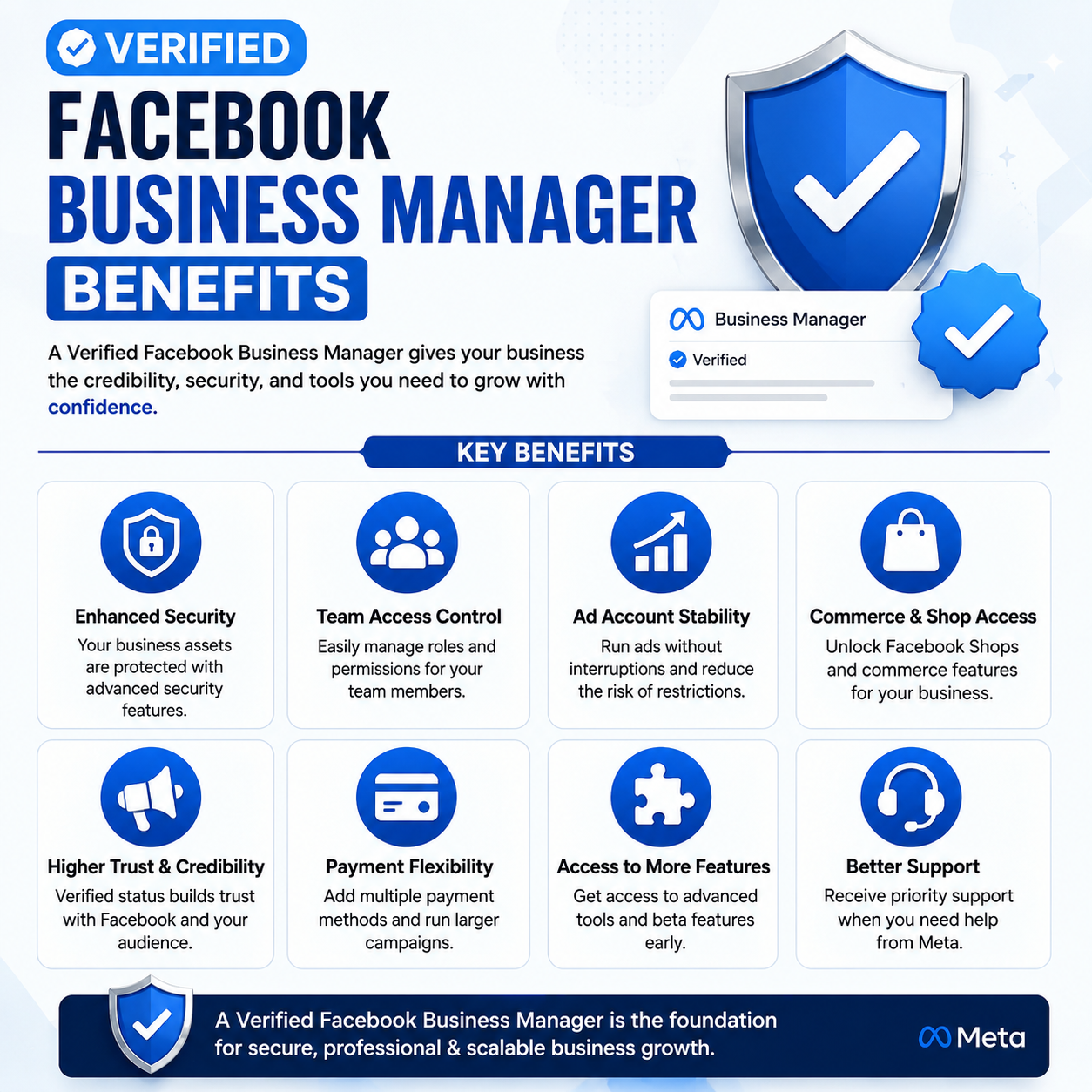
Running ads on Facebook without a verified Business Manager feels like driving without insurance. Everything works fine until it doesn't. Then you're stuck. Verification isn't just a checkbox Meta throws at advertisers for fun. It unlocks real advantages that shape how far your campaigns can scale, how safe your assets stay, and how much trust buyers place in your account when you decide to sell it.
Below, we'll dig into why verified Business Managers outperform unverified ones, and what practical perks come bundled with that little blue confirmation.
What Verification Actually Means
Meta's verification process confirms your business identity through documents: registration papers, tax IDs, utility bills, sometimes a phone call. Once approved, your Business Manager gets flagged as legitimate inside Meta's system. This isn't cosmetic. Behind the scenes, verified accounts get treated differently by algorithms governing ad delivery, account restrictions, and spending limits.
Unverified managers exist in a kind of probationary limbo. Meta watches them closely, and restricts them faster whenever something looks off. A verified account, by contrast, earns baseline credibility that unverified ones simply lack.
Higher Ad Spending Limits
New or unverified Business Managers often hit a wall around $250 daily spend, sometimes less. Scaling past that ceiling without verification is nearly impossible for many advertisers. Verified accounts routinely see limits jump into thousands of dollars per day, occasionally with no hard cap at all.
For agencies managing multiple client campaigns, or ecommerce brands pushing aggressive holiday promotions, this distinction separates hobbyists from serious operators. You cannot scale a $50,000 monthly ad budget through an account still stuck at entry-level thresholds. Verification removes that bottleneck almost immediately.
Reduced Risk of Sudden Account Bans
Meta's automated systems flag suspicious activity constantly, and unverified accounts sit squarely in the crosshairs. A verified Business Manager signals legitimacy to these systems, lowering the odds of getting caught in mass suspension waves that sweep through unverified accounts periodically.
This doesn't grant immunity. Policy violations still get punished regardless of verification status. But when Meta runs sweeping fraud checks, verified accounts survive at noticeably higher rates than their unverified counterparts. Fewer false positives, fewer three-a.m. panic moments checking whether your ad account got nuked overnight.
Access to Advanced Features
Certain tools stay locked behind verification walls. Custom audiences built from larger datasets, expanded API access, higher-tier support channels; these often require verified status before Meta grants entry.
Businesses relying on sophisticated retargeting strategies, or those integrating Facebook's advertising API into proprietary software, find themselves blocked without verification. It's frustrating watching competitors leverage tools you technically qualify for, except your account status disqualifies you on a technicality.
Increased Trust When Buying or Selling Assets
A thriving marketplace exists for buying and selling aged, verified Facebook Business Managers. Buyers pay premium prices for verified accounts precisely because verification signals reduced risk. Nobody wants to purchase an account that gets banned three days later.
Sellers benefit too. Verified Business Managers command higher resale value, sometimes double or triple what unverified equivalents fetch. If you're building assets with resale intent, whether running an agency flipping accounts or simply diversifying digital holdings, verification transforms a mediocre asset into something genuinely marketable.
Better Standing With Meta Support
Ever tried contacting Facebook support with an unverified account? Responses arrive slowly, if they arrive whatsoever. Verified businesses, however, frequently gain access to dedicated support channels, sometimes including direct account representatives for larger spenders.
When disputes arise, whether over disapproved ads, payment issues, or account restrictions, verified status often means faster resolution. Meta prioritizes accounts demonstrating legitimate business operations. That priority translates into real, measurable time saved chasing down support tickets that otherwise vanish into automated queues.
Multiple Ad Accounts Under One Roof
Unverified Business Managers frequently face restrictions on how many ad accounts they can create or manage. Agencies juggling dozens of clients need flexibility here, and verification typically expands those limits considerably.
Rather than juggling separate Business Managers for each client, fragmenting your workflow across disconnected dashboards, verification lets you consolidate operations. Centralized management saves time, reduces administrative headaches, and simplifies reporting across campaigns.
Stronger Domain Verification Synergy
Domain verification and Business Manager verification aren't identical, though they work together nicely. Combining both strengthens your overall account profile in Meta's eyes. Advertisers running iOS 14.5+ campaigns particularly benefit, since domain verification affects event prioritization and conversion tracking accuracy.
Pairing verified domains with a verified Business Manager creates layered credibility. Meta's systems cross-reference these signals, and accounts checking multiple legitimacy boxes simply perform better across nearly every metric that matters.
Long-Term Stability for Serious Advertisers
Anyone treating Facebook advertising as a long-term revenue channel, rather than a quick experiment, should prioritize verification early. Unverified accounts function fine temporarily, sure, but they're fragile foundations for anything built to last.
Verification isn't merely defensive insurance against bans. It's offensive positioning too, unlocking spend capacity, feature access, and marketplace value simultaneously. Advertisers who skip this step often discover its importance only after hitting a wall, usually mid-campaign, usually at the worst possible moment.